Recherche

L'Économie en centre-ville d’Orléans : le LÉO et le futur campus universitaire ouvriront sur le site Porte-Madeleine en Septembre 2027

Recherche

Pourquoi est-il si difficile de réformer les retraites en France ? Une réflexion d'Anne Lavigne, Professeur en économie au LÉO et conseillère au COR de 2016 à 2022

Le LÉO est un laboratoire d'économie rassemblant des enseignants-chercheurs de l'Université Clermont-Auvergne, de l'Université d'Orléans et de l'Université de Tours.

Il comprend une centaine de membres, dont les recherches couvrent trois grands domaines de compétence :

logo-univ-orléans

Actualités du laboratoire

Recherche

 placeholder
10/02/2026

Intervention de Catherine BROS sur France Culture : les relations stratégiques entre l’UE et l’Inde

Maison des Sciences de l’Homme Val de Loire
23/01/2026

Journée d’étude “Le Seigneuriage”

16/04/2026

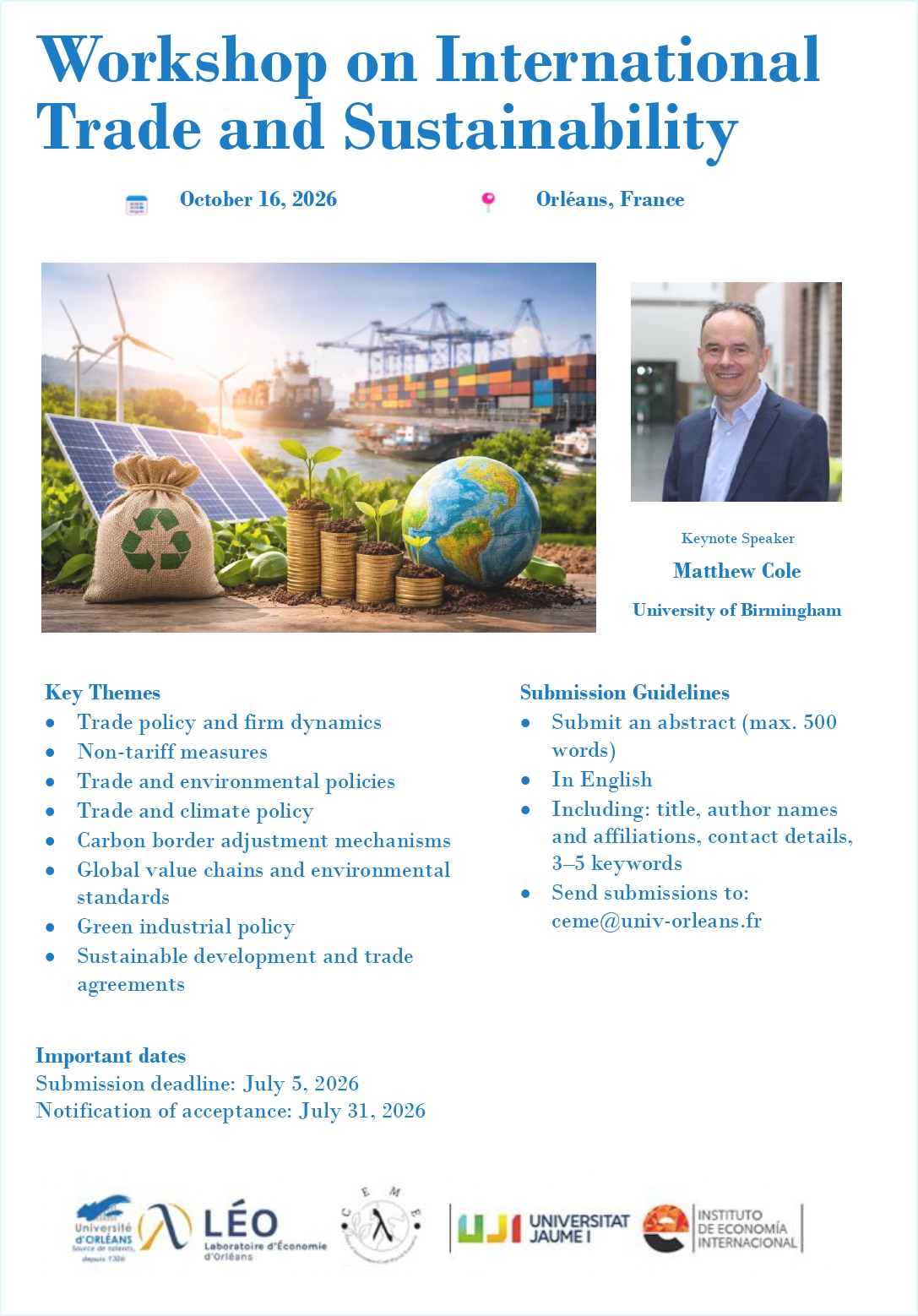
EENR 2026 – Environmental Economics: a focus on Natural Resources

06/02/2026

ORRM – Orléans Meetings on Responsible Resources

19/09/2025

1ère Conférence Annuelle « Les ECOPOL »

07/10/2025

Les mutations de la finance dans un monde fragmenté

Enseignement

15/01/2026

Replicating Bitcoin Performance: A Connectedness Analysis of Equity Portfolios

27/11/2025

Transforming Under Pressure : Climate Risks, GVCs, and Structural Change

02/10/2025

First-year PhD Students Presentation

19/06/2025

Should I Wait or Should I Pay? The Dynamics of Private and Public Healthcare

05/06/2025

Should the Central Bank react? Extreme Weather Events and Price Dynamics in the Philippines

22/05/2025

Seeing Through the Algorithm: How Explainability Shapes Decision-Making on Robo-Advisor Platforms

Dernières publications

> Toutes les publications

Tight belts, different cuts: How political preferences shape the effects of fiscal rules

Dorian Balvir


2026

While fiscal rules are often viewed as an effective way to curb the deficit bias arising from, inter alia, partisan pressures in common-pool budget settings, much less is known about how their effects vary with partisan preferences. This paper fills that gap by estimating local projections for a panel of EU-27 countries over 1995-2019. We innovatively link COFOG expenditure categories with the Manifesto Project Database to study how political preferences condition the impact of tighter fiscal rules across spending functions. Our first result is that more stringent national fiscal rules are associated with lower public spending in the short-and medium-run. Digging deeper, we show that the recomposition of expenditure under tighter rules depends on governments' preferences: adjustment falls disproportionately on categories that are less favoured by the incumbent. These results are robust to alternative estimators, different definitions of the dependent variable, and placebo tests. Lastly, the cuts associated with stricter fiscal rules in low-preference government contexts are amplified when sovereign debt yields are higher.
Lien HAL

Heat and Hurdles: Unpacking the Impact of Climate Risks on Women's Empowerment

City Eldeep, Fida Karam, Chahir Zaki


2026

Climate change poses complex risks that extend beyond environmental impacts, shaping social and economic inequalities. This paper examines how physical risks, such as extreme weather, and transition risks, linked to decarbonization and green policies, affect women's empowerment in firms across developing and developed contexts. Using firm-level data from the World Bank Enterprise Surveys and World Development Indicators, we measure empowerment through female employment, management, and ownership. Our results reveal contrasting effects: physical risks reduce female ownership, while transition risks boost female management, particularly in smaller, younger, non-exporting, and non-privately owned firms. The negative impact of physical risks is largely uniform, except in foreign-owned firms, and operates mainly through constraints on finance and land. These findings highlight the need for integrated climate and gender policies that recognize women not only as vulnerable to climate change but also as key agents of sustainable economic transformation.
Lien HAL

Trading Returns for Privacy: Experimental Evidence from Financial Data Leaks

Mehdi Louafi


2026

This paper provides benchmark experimental evidence on how individuals trade off financial performance against the risk of disclosing their own financial information when privacy risks are explicit, and outcomes are immediate. In a laboratory investment task with repeated decisions, participants choose between two risky options that differ in expected return and in an explicitly stated probability that choosing one option triggers a pseudonymous disclosure of a limited subset of their pre-elicited financial information to other participants. Participants respond systematically to both return spreads and leak probabilities, but choices are substantially more elastic to financial incentives than to changes in leak risk. In dynamic analyses, experiencing an own leak has modest and short-lived effects, whereas higher leakage among other participants is followed by a lower propensity to select the privacy-risky option. Standard measures of risk and loss aversion and most economic characteristics explain little of the heterogeneity in choices, while context-relevant privacy attitudes are associated with more privacy-protective behavior. Overall, in this transparent-probability benchmark environment, monetary incentives dominate leak risk on average, while social information about others' leaks meaningfully shapes behavior.
Lien HAL

Fiscal Rules and Environmental Spending: Navigating the Trade- off between Discipline and Green Priorities

Ablam Estel Apeti, Bao We Wal Bambe, Jean-Louis Combes, Pascale Combes Motel, Rayangnewendé Frans Sawadogo


2026

Environmental concerns are becoming more pressing as the climate emergency intensifies, posing a major challenge for many governments: increasing green investments to promote better adaptation and resilience to climate events, while maintaining fiscal discipline. This raises the question of whether governments that operate under fiscal rules tend to safeguard environmental spending in light of the climate emergency, or whether they are more inclined to scale it back to meet their fiscal targets, given that such investments require substantial public funding. Using data covering 31 advanced economies between 1995 and 2021, we find robust evidence that the strengthening of fiscal rules significantly reduces environmental spending, in particular debt rules and expenditure rules. Moreover, the adverse impact of fiscal rules on environmental expenditures is amplified during election periods, whereas it is mitigated in the presence of sound past fiscal conditions, the Kyoto Protocol, and stringent environmental policies. Further analysis reveals that although fiscal rules tend to reduce environmental spending, they are associated with greater efficiency in such spending.
Lien HAL

Public Health as a Buffer for FDI: The Role of Healthcare Services in Economic Stability

Zahra Khalilzadeh Silabi


2026

This study examines how epidemic outbreaks influence foreign direct investment (FDI) inflows in developing countries, with a particular focus on whether healthcare systems can act as buffers during such shocks. Using a panel dataset of 98 countries from 2000 to 2022, the analysis combines two-way fixed effects (FE) models and the Local Projection Method (LPM). The analysis is structured in three parts: First, fixed-effects regressions assess the average effect of 20 major epidemics on FDI, revealing that diseases such as Ebola, MERS, Lassa Fever, and Leptospirosis significantly reduce investment inflows. Second, local projection methods trace the short-and medium-term responses of FDI to health shocks by transmission type. The results show varying recovery patterns: while FDI tends to rebound after direct contact or mosquito-borne outbreaks, airborne diseases cause more persistent declines. Third, the study explores whether stronger healthcare systems can mitigate these negative effects. Results suggest that countries with a higher density of nurses experience less severe FDI losses during outbreaks, particularly for diseases transmitted through direct contact or bodily fluids. These findings underline the importance of healthcare investment not only for public health but also for economic resilience. By distinguishing effects across disease types and highlighting the moderating role of health infrastructure, this study offers practical insights for policymakers seeking to safeguard investment flows during times of crisis.
Lien HAL

Willingness to pay for the environment : the role of social status and of prosocial orientation

Martin Cimetiere, Sébastien Galanti


2026

Based on the 2020 International Social Survey Program (ISSP) IV Environment Module, this paper examines how individual characteristics influence the willingness to pay to protect the environment. We contribute to the literature by highlighting the role of social status: the higher respondents place themselves on the social scale, the more they are willing to pay; and of prosocial orientation: the more willing respondents are to take action for the environment independently of others, the more they are willing to pay. We underline that the impact of social status, i.e., respondents' subjective perception of their position on the social scale, remains significant even after controlling for income and education levels. Our results suggest that, in order to strengthen individuals' willingness to pay for the environment, two types of policies may be effective: (1) policies aimed at influencing subjective social status and its determinants -for example, exposing professional groups to narratives framing their position as socially valued, reducing perceived inequalities, enhancing individuals' sense of control over life events, and fostering orientation toward long-term planning; and (2) policies aimed at shaping prosocial orientation, that is, convincing individuals that personal actions are meaningful even when they are not widely adopted by others. Besides, based on our results, climate policies can be successful when imposing net costs on the following groups: individuals who rank themselves in the top 40% of the population (social status); the 50% of individuals who agree to act without waiting for others to do so (prosocial orientation). By contrast, climate policies that impose net costs on the complementary segments of the population are likely to face disapproval.
Lien HAL

Documents de recherche

> Tous les documents

Tight belts, different cuts: How political preferences shape the effects of fiscal rules

Dorian Balvir


2026

Heat and Hurdles: Unpacking the Impact of Climate Risks on Women's Empowerment

City Eldeep, Fida Karam, Chahir Zaki


2026

Trading Returns for Privacy: Experimental Evidence from Financial Data Leaks

Mehdi Louafi


2026

Fiscal Rules and Environmental Spending: Navigating the Trade- off between Discipline and Green Priorities

Ablam Estel Apeti, Bao We Wal Bambe, Jean-Louis Combes, Pascale Combes Motel, Rayangnewendé Frans Sawadogo


2026

Public Health as a Buffer for FDI: The Role of Healthcare Services in Economic Stability

Zahra Khalilzadeh Silabi


2026

Willingness to pay for the environment : the role of social status and of prosocial orientation

Martin Cimetiere, Sébastien Galanti


2026

Nous connaître

Le Léo en bref 2024

articles publiés
ouvrage
contribution à ouvrage
manifestations scientifiques organisées nationales et internationales
documents de recherche